Clifford data regression
CDR is an error mitigation method which predicts the noiseless value using training data, which can be generated by exact estimator such as a simulator and a noisy estimator such as a real device. The method consists of three steps:
(1) To generate noisless training data through efficient simulation using a classical computer, generate several approximate circuits in which non-Clifford gates are replaced by Clifford gates. Clifford gate can be configured with \(H\), \(S\), and CNOT gates. According to Gottesman-Knill theorem, quantum circuits consisting of Clifford gates can be efficiently simulated on a classical computer. A circuit containing non-Clifford gates can also be simulated using techniques derived from the Clifford circuit simulation method. However, the cost typically grows exponentially with the number of T gates. Therefore, reducing the number of T gates is essential to make the simulation feasible.
(2) The expectaion value \(\langle O \rangle_\mathrm{noiseless}\) in a noiseless situation is calculated by using the generated approximate circuit, and the expectation value \(\langle O \rangle_\mathrm{noisy}\) in a noisy situation is calculated by a noisy estimator such as a real device. This allows us to collect training data sets \(\{(\langle O \rangle_\mathrm{noiseless}, \langle O \rangle_\mathrm{noisy}), \cdots\}\).
(3) For a given model \(f(\langle O \rangle_\mathrm{noisy}, \boldsymbol{a})\), where \(\boldsymbol{a} \in \mathbb{R}^m\) and \(m\) is the number of parameters, optimize parameters \(\boldsymbol{a}\) to minimize loss function \(\sum_i\{f(\langle O \rangle_\mathrm{noisy}^i, \boldsymbol{a})-\langle O \rangle_\mathrm{noiseless}^i\}^2\). The trained model \(f(\langle O \rangle_\mathrm{noisy}, \boldsymbol{a}_{\mathrm{opt}})\) returns noiseless expectation value for given noisy expectation value.
This technique is available even for large systems in the sense that Clifford+T circuits with moderate number of T gates can be simulated efficiently on a classical computer.
Prerequisite
QURI Parts modules used in this tutorial: quri-parts-algo, quri-parts-circuit, quri-parts-core and quri-parts-qulacs. You can install them as follows:
# !pip install "quri-parts[qulacs]"
Preparation and overview
Here, we prepare the circuit and the noise model we use throughout this tutorial. The circuit we use in this tutorial consists of an identity part and a non-trivial part. The non-trivial part is responsible for converting the state \(|000\rangle\) into \(\frac{1}{\sqrt{2}}\left(|000\rangle + |111\rangle\right)\), while we decompose the identity circuit into multiple gates to amplify the effect of the noises.
from quri_parts.circuit import QuantumCircuit
from quri_parts.circuit.utils.circuit_drawer import draw_circuit

qubit_count = 3

identity_circuit = QuantumCircuit(3)
identity_circuit.add_RX_gate(0, 1.3)
identity_circuit.add_RY_gate(1, 0.2)
identity_circuit.add_RZ_gate(0, -2.3)
identity_circuit.add_SqrtXdag_gate(1)
identity_circuit.add_T_gate(0)
identity_circuit.add_RX_gate(1, 0.4)
identity_circuit.add_RY_gate(0, 2.7)
identity_circuit.add_Tdag_gate(1)
identity_circuit.add_RY_gate(0, -2.7)
identity_circuit.add_T_gate(1)
identity_circuit.add_Tdag_gate(0)
identity_circuit.add_RX_gate(1, -0.4)
identity_circuit.add_RZ_gate(0, 2.3)
identity_circuit.add_SqrtX_gate(1)
identity_circuit.add_RX_gate(0, -1.3)
identity_circuit.add_RY_gate(1, -0.2)

circuit = QuantumCircuit(3)
circuit += identity_circuit
circuit.add_H_gate(0)
circuit.add_CNOT_gate(0, 1)
circuit.add_CNOT_gate(0, 2)


print("The circuit:")
draw_circuit(circuit, line_length=200)
The circuit:
   ___     ___     ___     ___     ___     ___     ___     ___     ___
  |RX |   |RZ |   | T |   |RY |   |RY |   |Tdg|   |RZ |   |RX |   | H |
--|0  |---|2  |---|4  |---|6  |---|8  |---|10 |---|12 |---|14 |---|16 |-----●-------●---
  |___|   |___|   |___|   |___|   |___|   |___|   |___|   |___|   |___|     |       |
   ___     ___     ___     ___     ___     ___     ___     ___             _|_      |
  |RY |   |sXd|   |RX |   |Tdg|   | T |   |RX |   |sqX|   |RY |           |CX |     |
--|1  |---|3  |---|5  |---|7  |---|9  |---|11 |---|13 |---|15 |-----------|17 |-----|---
  |___|   |___|   |___|   |___|   |___|   |___|   |___|   |___|           |___|     |
                                                                                   _|_
                                                                                  |CX |
----------------------------------------------------------------------------------|18 |-
                                                                                  |___|
Then, we create a noise model with some NoiseInstructions. Here we consider BitFlipNoise and DepolarizingNoise.
from quri_parts.circuit.noise import (
    BitFlipNoise,
    DepolarizingNoise,
    NoiseModel,
)

noise_model = NoiseModel([
    BitFlipNoise(error_prob=0.01),
    DepolarizingNoise(error_prob=0.01),
])
Clifford data regression and peformance
Here, we explicitly show how to build an estimator that performs CDR. In this simple example, we will compare the performance of a CDR estimator with that of noiseless and noisy esimators. We first prepare an operator for this purpose.
from quri_parts.core.operator import Operator, pauli_label, PAULI_IDENTITY
op = Operator({
    pauli_label("Z0"): 0.25,
    pauli_label("Z1 Z2"): 2.0,
    pauli_label("X1 X2"): 0.5,
    pauli_label("Z1 Y2"): 1.0,
    pauli_label("X1 Y2"): 2.0,
    PAULI_IDENTITY: 3.0,
})
Next, we build a CDR estimator. In this example, the CDR estimator we create performs a quadratic regression using 10 data points, which corresponds to using 10 different training circuits. Each training circuit is constructed by ramdomly replacing 50% of the non-Clifford gates to clifford gates.
from quri_parts.algo.mitigation.cdr import create_cdr_estimator, create_polynomial_regression
from quri_parts.qulacs.estimator import (
    create_qulacs_density_matrix_concurrent_estimator,
    create_qulacs_vector_concurrent_estimator
)

noiseless_concurrent_estimator = create_qulacs_vector_concurrent_estimator()
noisy_concurrent_estimator = create_qulacs_density_matrix_concurrent_estimator(noise_model)
poly_regression = create_polynomial_regression(order=2)

cdr_estimator = create_cdr_estimator(
    noisy_estimator=noisy_concurrent_estimator,
    exact_estimator=noiseless_concurrent_estimator,
    regression_method=poly_regression,
    num_training_circuits=10,
    fraction_of_replacement=0.5
)
With the CDR estimator at hand, let’s compare it’s performance against the noiseless and noisy estimators.
from quri_parts.core.state import quantum_state
from quri_parts.qulacs.estimator import create_qulacs_vector_estimator, create_qulacs_density_matrix_estimator

state = quantum_state(qubit_count, circuit=circuit)

noiseless_estimator = create_qulacs_vector_estimator()
exact_estimate = noiseless_estimator(op, state)
print(f"Noiseless estimate: {exact_estimate.value}")

noisy_estimator = create_qulacs_density_matrix_estimator(noise_model)
noisy_estimate = noisy_estimator(op, state)
print(f"Noisy estimate: {noisy_estimate.value}")

cdr_estimate = cdr_estimator(op, state)
print(f"CDR estimate: {cdr_estimate.value}")
Noiseless estimate: (4.999999999999998+0j)
Noisy estimate: (4.409201598385634+0j)
---------------------------------------------------------------------------
AttributeError                            Traceback (most recent call last)
Cell In[11], line 17
     14 noisy_estimate = noisy_estimator(op, state)
     15 print(f"Noisy estimate: {noisy_estimate.value}")
---> 17 cdr_estimate = cdr_estimator(op, state)
     18 print(f"CDR estimate: {cdr_estimate.value}")

File ~/.cache/pypoetry/virtualenvs/quri-sdk-notebooks-AzU4R8Lq-py3.11/lib/python3.11/site-packages/quri_parts/algo/mitigation/cdr/cdr.py:302, in create_cdr_estimator.<locals>.cdr_estimator(obs, state)
    298 def cdr_estimator(
    299     obs: Estimatable, state: GeneralCircuitQuantumState
    300 ) -> Estimate[complex]:
    301     circuit = state.circuit
--> 302     cdr_value = cdr(
    303         obs,
    304         circuit,
    305         noisy_estimator,
    306         exact_estimator,
    307         regression_method,
    308         num_training_circuits,
    309         fraction_of_replacement,
    310         seed,
    311     )
    312     return _Estimate(value=cdr_value)

File ~/.cache/pypoetry/virtualenvs/quri-sdk-notebooks-AzU4R8Lq-py3.11/lib/python3.11/site-packages/quri_parts/algo/mitigation/cdr/cdr.py:261, in cdr(obs, circuit, noisy_estimator, exact_estimator, regression_method, num_training_circuits, fraction_of_replacement, seed)
    254 values_noise = [exp.value.real for exp in noisy_estimator([obs], [circuit_state])][
    255     0
    256 ]
    257 training_circuit_states = [
    258     GeneralCircuitQuantumState(i.qubit_count, i) for i in training_circuits
    259 ]
    260 values_exact_training = [
--> 261     exp.value.real for exp in exact_estimator([obs], training_circuit_states)
    262 ]
    263 values_noise_training = [
    264     exp.value.real for exp in noisy_estimator([obs], training_circuit_states)
    265 ]
    267 return regression_method(
    268     values_noise, values_noise_training, values_exact_training
    269 ).real

File ~/.cache/pypoetry/virtualenvs/quri-sdk-notebooks-AzU4R8Lq-py3.11/lib/python3.11/site-packages/quri_parts/qulacs/estimator.py:157, in create_qulacs_vector_concurrent_estimator.<locals>.estimator(operators, states)
    153 def estimator(
    154     operators: Collection[Estimatable],
    155     states: Collection[QulacsStateT],
    156 ) -> Iterable[Estimate[complex]]:
--> 157     return _concurrent_estimate(
    158         _sequential_estimate,
    159         _sequential_estimate_single_state,
    160         operators,
    161         states,
    162         executor,
    163         concurrency,
    164     )

File ~/.cache/pypoetry/virtualenvs/quri-sdk-notebooks-AzU4R8Lq-py3.11/lib/python3.11/site-packages/quri_parts/qulacs/estimator.py:142, in _concurrent_estimate(_sequential_estimate, _sequential_estimate_single_state, operators, states, executor, concurrency)
    140 if num_ops == 1:
    141     operators = [next(iter(operators))] * num_states
--> 142 return execute_concurrently(
    143     _sequential_estimate, None, zip(operators, states), executor, concurrency
    144 )

File ~/.cache/pypoetry/virtualenvs/quri-sdk-notebooks-AzU4R8Lq-py3.11/lib/python3.11/site-packages/quri_parts/core/utils/concurrent.py:40, in execute_concurrently(fn, common_input, individual_inputs, executor, concurrency)
     37 individual_input_list = list(individual_inputs)
     39 if executor is None:
---> 40     return list(fn(common_input, individual_input_list))
     42 input_counts = [
     43     (len(individual_input_list) + i) // concurrency for i in range(concurrency)
     44 ]
     45 input_list = [
     46     individual_input_list[
     47         sum(input_counts[:i]) : sum(input_counts[: i + 1])  # noqa: E203
     48     ]
     49     for i in range(concurrency)
     50 ]

File ~/.cache/pypoetry/virtualenvs/quri-sdk-notebooks-AzU4R8Lq-py3.11/lib/python3.11/site-packages/quri_parts/qulacs/estimator.py:84, in _sequential_estimate(_, op_state_tuples)
     81 def _sequential_estimate(
     82     _: Any, op_state_tuples: Sequence[tuple[Estimatable, QulacsStateT]]
     83 ) -> Sequence[Estimate[complex]]:
---> 84     return [_estimate(operator, state) for operator, state in op_state_tuples]

File ~/.cache/pypoetry/virtualenvs/quri-sdk-notebooks-AzU4R8Lq-py3.11/lib/python3.11/site-packages/quri_parts/qulacs/estimator.py:84, in <listcomp>(.0)
     81 def _sequential_estimate(
     82     _: Any, op_state_tuples: Sequence[tuple[Estimatable, QulacsStateT]]
     83 ) -> Sequence[Estimate[complex]]:
---> 84     return [_estimate(operator, state) for operator, state in op_state_tuples]

File ~/.cache/pypoetry/virtualenvs/quri-sdk-notebooks-AzU4R8Lq-py3.11/lib/python3.11/site-packages/quri_parts/qulacs/estimator.py:66, in _estimate(operator, state)
     64     circuit = state.circuit._qulacs_circuit
     65 else:
---> 66     circuit = convert_circuit(state.circuit)
     67 qs_state = _create_qulacs_initial_state(state)
     68 op = convert_operator(operator, state.qubit_count)

AttributeError: 'qulacs_core.QuantumCircuit' object has no attribute 'add_Identity_gate'
state.circuit.gates
(QuantumGate(name='RX', target_indices=(0,), control_indices=(), classical_indices=(), params=(1.3,), pauli_ids=(), unitary_matrix=()),
 QuantumGate(name='RY', target_indices=(1,), control_indices=(), classical_indices=(), params=(0.2,), pauli_ids=(), unitary_matrix=()),
 QuantumGate(name='RZ', target_indices=(0,), control_indices=(), classical_indices=(), params=(-2.3,), pauli_ids=(), unitary_matrix=()),
 QuantumGate(name='SqrtXdag', target_indices=(1,), control_indices=(), classical_indices=(), params=(), pauli_ids=(), unitary_matrix=()),
 QuantumGate(name='T', target_indices=(0,), control_indices=(), classical_indices=(), params=(), pauli_ids=(), unitary_matrix=()),
 QuantumGate(name='RX', target_indices=(1,), control_indices=(), classical_indices=(), params=(0.4,), pauli_ids=(), unitary_matrix=()),
 QuantumGate(name='RY', target_indices=(0,), control_indices=(), classical_indices=(), params=(2.7,), pauli_ids=(), unitary_matrix=()),
 QuantumGate(name='Tdag', target_indices=(1,), control_indices=(), classical_indices=(), params=(), pauli_ids=(), unitary_matrix=()),
 QuantumGate(name='RY', target_indices=(0,), control_indices=(), classical_indices=(), params=(-2.7,), pauli_ids=(), unitary_matrix=()),
 QuantumGate(name='T', target_indices=(1,), control_indices=(), classical_indices=(), params=(), pauli_ids=(), unitary_matrix=()),
 QuantumGate(name='Tdag', target_indices=(0,), control_indices=(), classical_indices=(), params=(), pauli_ids=(), unitary_matrix=()),
 QuantumGate(name='RX', target_indices=(1,), control_indices=(), classical_indices=(), params=(-0.4,), pauli_ids=(), unitary_matrix=()),
 QuantumGate(name='RZ', target_indices=(0,), control_indices=(), classical_indices=(), params=(2.3,), pauli_ids=(), unitary_matrix=()),
 QuantumGate(name='SqrtX', target_indices=(1,), control_indices=(), classical_indices=(), params=(), pauli_ids=(), unitary_matrix=()),
 QuantumGate(name='RX', target_indices=(0,), control_indices=(), classical_indices=(), params=(-1.3,), pauli_ids=(), unitary_matrix=()),
 QuantumGate(name='RY', target_indices=(1,), control_indices=(), classical_indices=(), params=(-0.2,), pauli_ids=(), unitary_matrix=()),
 QuantumGate(name='H', target_indices=(0,), control_indices=(), classical_indices=(), params=(), pauli_ids=(), unitary_matrix=()),
 QuantumGate(name='CNOT', target_indices=(1,), control_indices=(0,), classical_indices=(), params=(), pauli_ids=(), unitary_matrix=()),
 QuantumGate(name='CNOT', target_indices=(2,), control_indices=(0,), classical_indices=(), params=(), pauli_ids=(), unitary_matrix=()))
Building the CDR estimator step by step
Now we start to explain all the steps necessary to construct a CDR estimator. This involves:
Build a set of training circuits
Collect data from the training ciricuits. The data is a sequence of noisy estimates and the corresponding noiseless estimates $\( \begin{equation} \{\left( \langle O \rangle _{\text{noisy}}, \langle O \rangle _{\text{noiseless}} \right), \cdots\} \end{equation} \)$
Pick a regression scheme to predict the noiseless result from noisy estimation of the noisy estimator.
Create training data
Next, we create training circuits and data. Training circuits are generated by replacing randomly chosen non-Clifford gates in the circuit with the closest Clifford gates. The number of non-Clifford gates determines the computational cost for Clifford+T simulator. Here, we generate 8 training circuits and each circuit has 6 non-Clifford gates.
After generating training circuit, we calculate the estimates for exact and noisy estimators.
from quri_parts.algo.mitigation.cdr import make_training_circuits

training_circuits = make_training_circuits(circuit, num_non_clifford_untouched=6, num_training_circuits=8)

for i, training_circuit in enumerate(training_circuits):
    print(f"training circuit: {i}")
    draw_circuit(training_circuit, line_length=200)
training circuit: 0
   ___     ___     ___     ___     ___     ___     ___     ___     ___
  |RX |   |RZ |   | S |   | Y |   | Y |   |Sdg|   | S |   |sXd|   | H |
--|0  |---|2  |---|4  |---|6  |---|8  |---|10 |---|12 |---|14 |---|16 |-----●-------●---
  |___|   |___|   |___|   |___|   |___|   |___|   |___|   |___|   |___|     |       |
   ___     ___     ___     ___     ___     ___     ___     ___             _|_      |
  |RY |   |sXd|   |RX |   |Tdg|   | S |   |RX |   |sqX|   |UDF|           |CX |     |
--|1  |---|3  |---|5  |---|7  |---|9  |---|11 |---|13 |---|15 |-----------|17 |-----|---
  |___|   |___|   |___|   |___|   |___|   |___|   |___|   |___|           |___|     |
                                                                                   _|_
                                                                                  |CX |
----------------------------------------------------------------------------------|18 |-
                                                                                  |___|
training circuit: 1
   ___     ___     ___     ___     ___     ___     ___     ___     ___
  |RX |   |Sdg|   | S |   | Y |   |RY |   |Tdg|   | S |   |sXd|   | H |
--|0  |---|2  |---|4  |---|6  |---|8  |---|10 |---|12 |---|14 |---|16 |-----●-------●---
  |___|   |___|   |___|   |___|   |___|   |___|   |___|   |___|   |___|     |       |
   ___     ___     ___     ___     ___     ___     ___     ___             _|_      |
  |RY |   |sXd|   |UDF|   |Tdg|   | S |   |RX |   |sqX|   |UDF|           |CX |     |
--|1  |---|3  |---|5  |---|7  |---|9  |---|11 |---|13 |---|15 |-----------|17 |-----|---
  |___|   |___|   |___|   |___|   |___|   |___|   |___|   |___|           |___|     |
                                                                                   _|_
                                                                                  |CX |
----------------------------------------------------------------------------------|18 |-
                                                                                  |___|
training circuit: 2
   ___     ___     ___     ___     ___     ___     ___     ___     ___
  |RX |   |Sdg|   | S |   |RY |   | Y |   |Sdg|   |RZ |   |sXd|   | H |
--|0  |---|2  |---|4  |---|6  |---|8  |---|10 |---|12 |---|14 |---|16 |-----●-------●---
  |___|   |___|   |___|   |___|   |___|   |___|   |___|   |___|   |___|     |       |
   ___     ___     ___     ___     ___     ___     ___     ___             _|_      |
  |RY |   |sXd|   |UDF|   |Sdg|   | T |   |UDF|   |sqX|   |RY |           |CX |     |
--|1  |---|3  |---|5  |---|7  |---|9  |---|11 |---|13 |---|15 |-----------|17 |-----|---
  |___|   |___|   |___|   |___|   |___|   |___|   |___|   |___|           |___|     |
                                                                                   _|_
                                                                                  |CX |
----------------------------------------------------------------------------------|18 |-
                                                                                  |___|
training circuit: 3
   ___     ___     ___     ___     ___     ___     ___     ___     ___
  |sqX|   |Sdg|   | T |   | Y |   |RY |   |Sdg|   | S |   |sXd|   | H |
--|0  |---|2  |---|4  |---|6  |---|8  |---|10 |---|12 |---|14 |---|16 |-----●-------●---
  |___|   |___|   |___|   |___|   |___|   |___|   |___|   |___|   |___|     |       |
   ___     ___     ___     ___     ___     ___     ___     ___             _|_      |
  |RY |   |sXd|   |UDF|   |Tdg|   | T |   |UDF|   |sqX|   |RY |           |CX |     |
--|1  |---|3  |---|5  |---|7  |---|9  |---|11 |---|13 |---|15 |-----------|17 |-----|---
  |___|   |___|   |___|   |___|   |___|   |___|   |___|   |___|           |___|     |
                                                                                   _|_
                                                                                  |CX |
----------------------------------------------------------------------------------|18 |-
                                                                                  |___|
training circuit: 4
   ___     ___     ___     ___     ___     ___     ___     ___     ___
  |sqX|   |RZ |   | S |   | Y |   |RY |   |Sdg|   |RZ |   |RX |   | H |
--|0  |---|2  |---|4  |---|6  |---|8  |---|10 |---|12 |---|14 |---|16 |-----●-------●---
  |___|   |___|   |___|   |___|   |___|   |___|   |___|   |___|   |___|     |       |
   ___     ___     ___     ___     ___     ___     ___     ___             _|_      |
  |UDF|   |sXd|   |UDF|   |Tdg|   | T |   |UDF|   |sqX|   |UDF|           |CX |     |
--|1  |---|3  |---|5  |---|7  |---|9  |---|11 |---|13 |---|15 |-----------|17 |-----|---
  |___|   |___|   |___|   |___|   |___|   |___|   |___|   |___|           |___|     |
                                                                                   _|_
                                                                                  |CX |
----------------------------------------------------------------------------------|18 |-
                                                                                  |___|
training circuit: 5
   ___     ___     ___     ___     ___     ___     ___     ___     ___
  |RX |   |RZ |   | S |   |RY |   | Y |   |Tdg|   | S |   |sXd|   | H |
--|0  |---|2  |---|4  |---|6  |---|8  |---|10 |---|12 |---|14 |---|16 |-----●-------●---
  |___|   |___|   |___|   |___|   |___|   |___|   |___|   |___|   |___|     |       |
   ___     ___     ___     ___     ___     ___     ___     ___             _|_      |
  |RY |   |sXd|   |UDF|   |Tdg|   | S |   |UDF|   |sqX|   |UDF|           |CX |     |
--|1  |---|3  |---|5  |---|7  |---|9  |---|11 |---|13 |---|15 |-----------|17 |-----|---
  |___|   |___|   |___|   |___|   |___|   |___|   |___|   |___|           |___|     |
                                                                                   _|_
                                                                                  |CX |
----------------------------------------------------------------------------------|18 |-
                                                                                  |___|
training circuit: 6
   ___     ___     ___     ___     ___     ___     ___     ___     ___
  |sqX|   |Sdg|   | T |   | Y |   |RY |   |Tdg|   | S |   |RX |   | H |
--|0  |---|2  |---|4  |---|6  |---|8  |---|10 |---|12 |---|14 |---|16 |-----●-------●---
  |___|   |___|   |___|   |___|   |___|   |___|   |___|   |___|   |___|     |       |
   ___     ___     ___     ___     ___     ___     ___     ___             _|_      |
  |UDF|   |sXd|   |UDF|   |Sdg|   | T |   |RX |   |sqX|   |UDF|           |CX |     |
--|1  |---|3  |---|5  |---|7  |---|9  |---|11 |---|13 |---|15 |-----------|17 |-----|---
  |___|   |___|   |___|   |___|   |___|   |___|   |___|   |___|           |___|     |
                                                                                   _|_
                                                                                  |CX |
----------------------------------------------------------------------------------|18 |-
                                                                                  |___|
training circuit: 7
   ___     ___     ___     ___     ___     ___     ___     ___     ___
  |RX |   |RZ |   | S |   | Y |   |RY |   |Sdg|   |RZ |   |sXd|   | H |
--|0  |---|2  |---|4  |---|6  |---|8  |---|10 |---|12 |---|14 |---|16 |-----●-------●---
  |___|   |___|   |___|   |___|   |___|   |___|   |___|   |___|   |___|     |       |
   ___     ___     ___     ___     ___     ___     ___     ___             _|_      |
  |UDF|   |sXd|   |UDF|   |Sdg|   | T |   |RX |   |sqX|   |UDF|           |CX |     |
--|1  |---|3  |---|5  |---|7  |---|9  |---|11 |---|13 |---|15 |-----------|17 |-----|---
  |___|   |___|   |___|   |___|   |___|   |___|   |___|   |___|           |___|     |
                                                                                   _|_
                                                                                  |CX |
----------------------------------------------------------------------------------|18 |-
                                                                                  |___|
Noisy estimation on training circuits
exact_estimates = noiseless_concurrent_estimator(
    [op], [quantum_state(qubit_count, circuit=training_circuit) for training_circuit in training_circuits]
)
exact_estimates = [e.value.real for e in exact_estimates]

print("exact estimates:")
print(exact_estimates)

noisy_estimates = noisy_concurrent_estimator(
    [op], [quantum_state(qubit_count, circuit=training_circuit) for training_circuit in training_circuits]
)
noisy_estimates = [e.value.real for e in noisy_estimates]
print("noisy estimates:")
print(noisy_estimates)
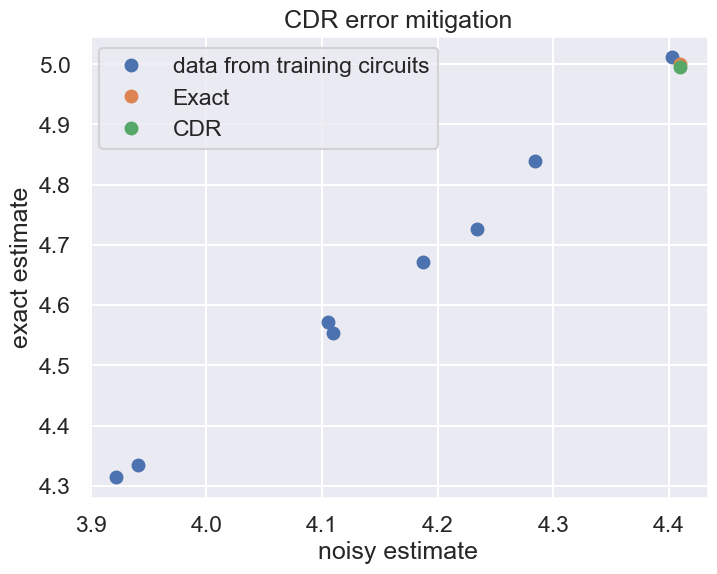
exact estimates:
[4.571368420223662, 4.725938607139674, 4.553399561554554, 4.840181114424471, 5.011915331184432, 4.671190940323665, 4.314567931739591, 4.335370993717824]
noisy estimates:
[4.1053636571491925, 4.233573548857111, 4.109449533963103, 4.2840278247817825, 4.402936220208613, 4.187134123532713, 3.921822410894969, 3.94079220528753]
Define the regression function and get the mitigated value
Finally, we predict noiseless value by regression. QURI Parts has multiple options for regression. Here we perform second-order polynomial regression.
from quri_parts.algo.mitigation.cdr import (
    create_polynomial_regression,
)

poly_regression = create_polynomial_regression(order=2)

mitigated_val = poly_regression(
    noisy_estimate.value, noisy_estimates, exact_estimates
).real

print(f"mitigated value: {mitigated_val}")
mitigated value: 5.025232022296151
import matplotlib.pyplot as plt
import seaborn as sns

sns.set_theme("talk")
plt.rcParams["figure.figsize"] = (8, 6)
plt.plot(noisy_estimates, exact_estimates, "o", label="data from training circuits")
plt.plot(
    [noisy_estimator(op, state).value.real], [noiseless_estimator(op, state).value.real], "o",
    label="Exact"
)
plt.plot(
    [noisy_estimator(op, state).value.real], [cdr_estimator(op, state).value.real], "o",
    label="CDR"
)
plt.xlabel("noisy estimate")
plt.ylabel("exact estimate")
plt.title("CDR error mitigation")
plt.legend()
plt.show()
Create the CDR estimator
You can also create a CDR estimator that performs CDR behind the scenes. Once it’s created, you can use it as a QuantumEstimator, which accepts Estimatable and ~QuantumState and returns Estimate.
from quri_parts.algo.mitigation.cdr import create_cdr_estimator

cdr_estimator = create_cdr_estimator(
    noisy_estimator=noisy_concurrent_estimator,
    exact_estimator=noiseless_concurrent_estimator,
    regression_method=poly_regression,
    num_training_circuits=10,
    fraction_of_replacement=0.5
)

estimate = cdr_estimator(op, state)
estimate
_Estimate(value=5.054745806576952, error=nan)